Shopify vs BigCommerce
Store Builders
Shopify vs BigCommerce
Shopify Review
Shopify is a popular eCommerce platform that makes it easy to create and manage an online store. It's suitable for beginners, small businesses, and growing brands. Its main advantage is its simplicity: adding products, managing payments, orders, marketing, and multichannel sales requires no advanced technical skills.
Shopify is also very interesting for eCommerce productivity, as it centralizes several important tasks: catalog management, checkout, promotions, analytics, inventory, shipping, automation, and integrations. The platform invests heavily in AI with features like Sidekick, theme improvements, AI-powered domain discovery, and updates to make store creation faster. Shopify has also launched a tool capable of generating stores from keywords, which can help new merchants get started more quickly.

For an affiliate website, Shopify is an excellent choice because the need is clear: many people are looking for ways to launch an online store. You can create articles like “Shopify Review,” “Shopify vs. BigCommerce,” “How to Create a Shopify Store,” or “Best Shopify Apps to Sell More.”
Verdict: Shopify is probably the best choice for recommending a simple, fast, and well-known eCommerce solution.
BigCommerce Review
BigCommerce is a robust and scalable SaaS eCommerce platform, suitable for businesses, advanced B2B/B2C stores, and large catalogs. It stands out for its performance, technical flexibility, native features, and ability to support long-term growth.
One of its major advantages is its Open SaaS approach: the platform combines cloud hosting, security, checkout, product management, order processing, and multichannel sales, while offering greater flexibility through APIs and integrations. BigCommerce also highlights use cases such as multi-storefront, B2B+B2C, complex catalogs, and omnichannel sales. It is therefore very attractive for merchants who want to avoid excessive reliance on external applications.
For an eCommerce affiliate site, BigCommerce is a great topic because it allows you to create high-quality comparative content. Many visitors aren't just looking for "the easiest platform," but want to know which solution to choose for a more serious, larger, or more customizable store. You can publish articles like "BigCommerce Review," "BigCommerce vs. Shopify," "Best eCommerce Platform for B2B," or "BigCommerce for Complex Catalogs."
Verdict: BigCommerce is an excellent option for merchants who want a more scalable and professional platform.
| Criteria | Shopify | BigCommerce |
|---|---|---|
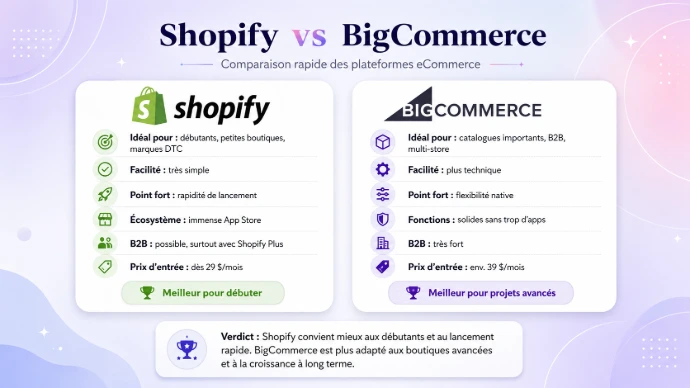
Ideal for | Beginners, small shops, DTC brands, designers, dropshipping | Boutiques plus avancées, B2B, catalogues importants, multi-store |
Ease of use | Very simple, intuitive interface, quick launch | More technical, but more flexible for complex projects |
Shop creation | AI website builder, ready-made themes, simple editor, Shopify Magic for product text and images | Complete eCommerce platform with Multi-Storefront, ERP/PIM/payment integrations and a more “Open SaaS” approach |
eCommerce Functions | Efficient checkout, inventory, payments, shipping, analytics, apps | Robust native features, multi-store, B2B, API, omnichannel sales |
Applications / intégrations | Very large App Store, ideal for quickly adding features | Less reliant on apps, more focused on native integrations/APIs |
B2B | Possible, especially with Shopify Plus and apps. | Very strong for B2B, complex catalogs and professional accounts |
Entry fee | Basic starting at $29/month with annual billing | Standard is generally around $39/month, or less annually depending on the offers; Pro starts at $399/month. |
| Scalabilité | Very good, especially with Shopify Plus | Excellent for complex, B2B, multi-brand and multi-country projects. |
Best strength | Simplicity + ecosystem + speed of launch | Flexibility + native features + advanced management |
Weak point | Apps can increase costs | Less simple for complete beginners |
Verdict
Shopify
is the best choice if you want to recommend a simple, popular, and fast solution for launching an online store. It's ideal for beginners, small businesses, creators, dropshipping, and brands that want to sell quickly.
BigCommerce
is better for more technically demanding stores: large catalogs, B2B, multi-storefront, international sales, and projects that require more native flexibility.